Structural Drying and Dehumidification in Fountain Valley, CA
Surface dry is not dry. The drying team dries the slab, the framing and the wall cavities to within 2 to 4 points of a dry reference, with daily readings that prove it.
(888) 450-9281House wet inside the walls? Start the dry-out now.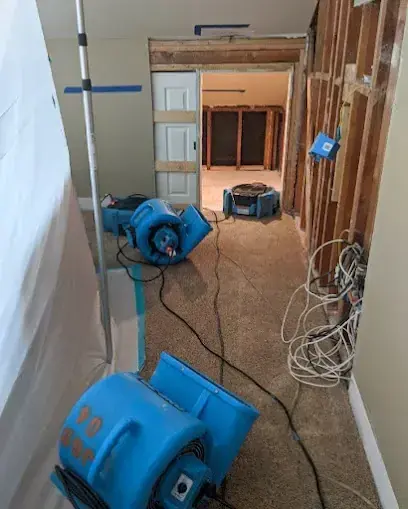
First steps for structural drying and dehumidification in Fountain Valley
- 1
Leave equipment running
Turning air movers or dehumidifiers off stalls the drying.
- 2
Keep doors and windows closed
The drying team controls the air; open windows bring in damp air.
- 3
Keep the heat steady
A steady indoor temperature helps evaporation.
- 4
Call with questions
If a unit stops or a breaker trips, call so it can be checked.
How structural drying and dehumidification work is done in Fountain Valley
Every water loss ends with structural drying. Extraction pulls the standing water, removal takes out what cannot be saved, and then the drying team has to dry what is left: the slab, the studs and bottom plates, the subfloor and the back of the drywall. In Fountain Valley that usually means concrete, which gives up water slowly, in a city where the ground under the slab is already damp.
What does structural drying and dehumidification cost in Fountain Valley, CA?
In Fountain Valley, CA, structural drying typically runs $1,000 to $4,000 for one or two rooms and $4,000 to $14,000 for a large or Class 4 loss, based on the equipment count and the number of drying days the readings call for.
One or two rooms
$1,000 to $3,000
Large loss
$3,000 to $8,000
Class 4 slab or hardwood
$8,000 to $14,000
Ranges are typical, not a quote: category of water, square footage, material class and how fast drying started move the number most. Run the Fountain Valley water damage cost calculator for a closer range.
The structural drying and dehumidification process in four steps
The tech who does the walkthrough maps moisture before any equipment goes down, so the drying plan matches what is actually wet. Equipment stays until the readings say dry, not until it looks dry.
Step 1 Map and set the goal
A moisture map and a dry reference set the target.
Step 2 Place equipment
Air movers and dehumidifiers go where the readings are highest.
Step 3 Read daily
Materials and air are logged every day and equipment is adjusted.
Step 4 Sign off
Equipment leaves when every reading is within the goal.
Sizing the equipment
The IICRC S500 standard sets the equipment by class of loss and the room's evaporation load. Class 1 is a small, low-wicking loss; Class 4 is water in dense materials like concrete, hardwood or plaster. Air movers are placed to keep air moving across wet surfaces, and LGR dehumidifiers remove the water that evaporates.
- Air movers placed to the room's evaporation load
- LGR dehumidifiers for most losses
- Desiccant dehumidifiers for Class 4 and cool rooms
Reading, not guessing
The drying team takes a dry reference reading from an unaffected part of the same house, then reads every wet material daily. Temperature and relative humidity are logged inside the drying area and outside it, so the psychrometric log shows the equipment is actually pulling water out. Equipment is moved toward whatever is still wet.
Dense materials and the slab
Concrete, hardwood and plaster need more than air. Drying mats pull water up out of the slab and wood floors, injection systems push dry air into wall cavities and under cabinets, and desiccant units dry the air further than an LGR unit can. The job ends when every reading falls within 2 to 4 points of the dry reference.
- Drying mats for slabs and hardwood
- Injection drying for cavities and cabinets
- Final readings logged for the claim
The EPA indoor air quality pages explain why indoor moisture is controlled, and Energy Saver covers humidity and ventilation in the home.
Structural drying and dehumidification across Fountain Valley and nearby cities
The Fountain Valley restoration crew covers ZIP 92708 and 92728, from the Mile Square Park area along Brookhurst Street, Magnolia Street and Bushard Street to Warner Avenue, Talbert Avenue and the east-side business park by the Santa Ana River.
Nearby coverage reaches Huntington Beach, Westminster, Costa Mesa, Santa Ana, Garden Grove, Stanton, Seal Beach, Cypress, Los Alamitos.
Related water damage services in Fountain Valley
Structural Drying and Dehumidification questions in Fountain Valley, CA
Still dealing with it?
Wet walls or a wet slab in Fountain Valley? Get them dried right.
(888) 450-9281Fountain Valley structural drying01What is structural drying?
Drying the building materials, not just the surfaces: slab, framing, subfloor and the back of the drywall, until they read dry.
02What is a dry reference reading?
A reading taken from the same kind of material in an unaffected room. Wet materials are dry when they read within 2 to 4 points of it.
03What is the difference between LGR and desiccant?
An LGR dehumidifier uses refrigeration and works for most losses. A desiccant unit uses a drying wheel and dries air further, which helps concrete, hardwood and cool rooms.
04Why is the equipment so loud?
Air movers push a lot of air to speed evaporation. The noise ends when the readings say dry.
05Can drying be done in a set number of days?
No. Materials dry at different speeds, so the readings set the finish, not the calendar.
06Is drying covered by insurance?
Drying is part of mitigation, which is often covered for sudden and accidental water. Coverage depends on your policy, so check with your own insurer.
House still wet in Fountain Valley? Get the drying started today.
Surface dry is not dry. Daily readings show when the slab and framing actually are.