Structural Drying and Dehumidification in Stanton, CA
After the water is removed, Stanton crews place air movers and dehumidifiers from a moisture map and keep reading every wall, floor and ceiling until each one reaches its dry goal.
(888) 450-9281Call for structural drying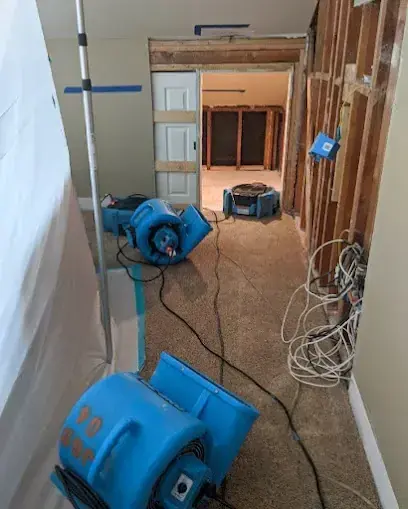
First steps for structural drying and dehumidification in Stanton
- 1
Finish the pump-out
Standing water has to be removed before dry-out equipment is placed.
- 2
Keep the area closed
Close doors and windows in wet rooms so the dehumidifiers can work.
- 3
Leave the equipment alone
Do not move or unplug air movers, since each one sits in a mapped spot.
- 4
Call for monitoring
Ask for daily readings and a written log for the adjuster.
How structural drying and dehumidification work is done in Stanton
Structural drying is what happens after extraction: the building itself, meaning framing, subfloor, drywall and concrete, is dried until it matches the moisture level of a dry reference. Stanton's summers are dry, with July and August at 0.0 inches of rain, and its wet season runs from December through March, but the drying follows the job and not the calendar. Water that sat in a wall or under a floor for a long time needs more equipment than a fresh spill.
What does structural drying and dehumidification cost in Stanton, CA?
Structural drying for one or two rooms costs $1,000 to $3,000 in Stanton. A large loss with many air movers and several dehumidifiers runs $3,000 to $8,000, and a Class 4 slab or hardwood job runs $8,000 to $14,000.
One or two rooms
$1,000 to $3,000
Large loss
$3,000 to $8,000
Class 4 slab or hardwood
$8,000 to $14,000
Ranges are typical, not a quote: category of water, square footage, material class and how fast drying started move the number most. Run the water damage cost calculator for a closer range.
The structural drying and dehumidification process in four steps
The tech who does the walkthrough maps moisture before any equipment goes down, so the drying plan matches what is actually wet. Equipment stays until the readings say dry, not until it looks dry.
Step 1 Map the moisture
Meters read every surface and mark the wet boundary.
Step 2 Place the equipment
Air movers and dehumidifiers go in where the map shows water.
Step 3 Monitor each day
Readings adjust the equipment until surfaces improve.
Step 4 Confirm dry
Equipment comes out only after every goal is reached.
How the equipment is chosen
Air movers push dry air across wet surfaces, and LGR dehumidifiers pull the moisture out of the room. Desiccant units are added when a slab or hardwood holds water too deep for refrigerant dehumidifiers to reach.
- Air movers are set along the wet walls and floors.
- LGR dehumidifiers run in a closed drying area.
- Desiccant units handle slabs and dense wood floors.
What the daily readings do
Every day a technician returns to read moisture content, room temperature and humidity, and then moves or removes equipment based on the numbers. Surfaces that dry first lose their air movers, and slower areas get more.
- Readings are taken at the same marked points each day.
- Equipment is added where a surface lags behind.
- Drying stops only when each point reaches its goal.
When a job needs more than air
Some losses need materials removed before they can dry, such as a wet ceiling or soaked padding, which is why extraction and demolition come first in water extraction. A hidden slab leak follows the steps in slab leak water damage, where mats and desiccant units do the heavy work.
Structural drying and dehumidification across Stanton and nearby towns
Structural drying crews work throughout Stanton, from the homes around Beach Boulevard and Katella Avenue to the apartments and shops near Western Avenue, Knott Avenue and Magnolia Avenue. The Stanton hub lists every water service the crews offer.
The same service nearby: structural drying and dehumidification in Fountain Valley, Cypress, Garden Grove.
Related water damage services in Stanton
Structural Drying and Dehumidification questions in Stanton, CA
Still dealing with it?
Walls still damp after the pump-out? A Stanton crew can place and monitor equipment.
(888) 450-9281Call for structural drying01How long does structural drying take?
It runs until every tracked reading reaches its goal, so the readings decide the end, not a set number of days.
02Why are dehumidifiers needed as well as fans?
Fans move the moisture off surfaces, and dehumidifiers remove it from the air, so both are needed for materials to actually dry.
03Can drying equipment be turned off at night?
No. Stopping the equipment lets moisture settle back into the materials and slows the dry-out.
04What is an LGR dehumidifier?
A low-grain refrigerant unit that pulls water vapor out of the air at lower humidity than a standard dehumidifier.
05When is desiccant drying used?
On slabs, hardwood floors and cold or dense materials that hold water deeper than standard equipment can reach.
06Is the drying log used for insurance?
Yes. Dated readings and equipment counts show the adjuster what was dried and how.
Damp materials keep holding water until equipment brings them to a dry goal.
Technicians in Stanton place equipment from a moisture map and return daily until each goal is met.