Structural Drying in Cypress, CA
After a leak in a Cypress home, structural drying sets air movers and dehumidifiers around the walls, flooring and subfloor, sized to the room, until moisture readings reach the dry target.
(888) 450-9281Call for structural drying in Cypress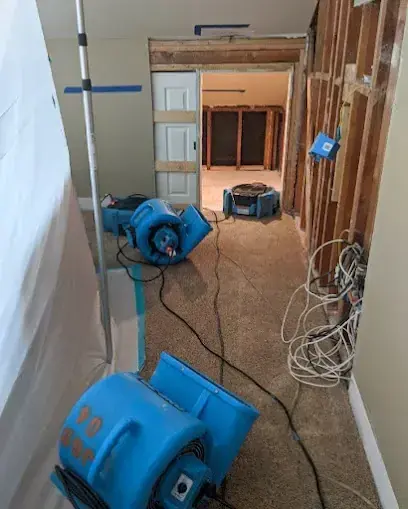
First steps for structural drying and dehumidification in Cypress
- 1
Stop the source
Repair or isolate the leak before equipment is set.
- 2
Close the area
Keep doors and windows closed in the wet area.
- 3
Leave it running
Do not switch off or move the equipment, since readings need steady airflow.
- 4
Expect daily visits
A technician returns daily to read meters and adjust equipment.
How structural drying and dehumidification work is done in Cypress
Drying is the part of a water loss that decides whether walls, floors and framing can stay. In Cypress homes, the work centers on walls, flooring and subfloor areas after a leak, with equipment sized to each room rather than set by a formula. The crew places air movers to drive moisture out of surfaces and dehumidifiers to take it out of the air so it does not return to the materials. Standing water is removed first through water extraction.
What does structural drying and dehumidification cost in Cypress, CA?
Drying cost follows the number of rooms, the count of air movers and dehumidifiers, and the days they run. One or two rooms stay in the lower range, while dense hardwood or slab drying with mats and desiccant units sits at the top.
One or two rooms
$1,000 to $3,000
Whole-room losses
$3,000 to $8,000
Class 4 slab or hardwood
$8,000 to $14,000
Ranges are typical, not a quote: category of water, square footage, material class and how fast drying started move the number most. Run the water damage cost calculator for a closer range.
The structural drying and dehumidification process in four steps
The tech who does the walkthrough maps moisture before any equipment goes down, so the drying plan matches what is actually wet. Equipment stays until the readings say dry, not until it looks dry.
Step 1 Survey
Meters and thermal imaging map every wet material before equipment is placed.
Step 2 Set equipment
Air movers and dehumidifiers go in, sized to the room and its materials.
Step 3 Read and adjust
Daily readings steer equipment moves until each point nears dry reference.
Step 4 Confirm and remove
Final readings pass, equipment is picked up and the log is handed over.
How equipment is placed
Air movers are aimed along wall bases and across floors so moving air strips moisture from the surface, and a low-grain refrigerant dehumidifier removes it from the room. Inside walls, small ports or opened bays let dry air reach the cavity directly. Doors and windows stay closed during drying so the dehumidifier is not fighting outside air.
- Air movers set along wall bases and across wet floors
- LGR dehumidifier sized to the room volume
- Cavity ports or open bays for wall drying
Reading the moisture
Meters record moisture at marked points each day, and the same points are used every visit so the numbers can be compared. The crew moves or removes equipment as areas dry, then keeps running it on the slowest spots, such as baseboards, hardwood edges and cabinet bases. A written log of those readings is what an adjuster uses to confirm the drying was complete.
- Same marked points read at every visit
- Equipment moved toward the slowest spots
- Daily log kept for the adjuster
Dense materials take longer
Hardwood, concrete and thick framing release water slowly, so a Class 4 loss can need drying mats, desiccant dehumidifiers and extra days. The crew explains the schedule in advance and adjusts it with the readings instead of a calendar. Slab leaks are covered in more detail under slab leak water damage.
Structural drying and dehumidification across Cypress and nearby towns
Structural drying runs in homes and condos across Cypress, from Oak Knoll to Cypress Village, and on streets such as Valley View Street, Katella Avenue and Denni Street in 90630, with equipment matched to each room.
The same service nearby: structural drying and dehumidification in Fountain Valley, Los Alamitos, Stanton.
Related water damage services in Cypress
Structural Drying and Dehumidification questions in Cypress, CA
Still dealing with it?
Wet framing stays wet until equipment and readings prove otherwise.
(888) 450-9281Call for Cypress structural drying01How many days will equipment stay in place?
Clean-water losses commonly need about three days, while hardwood, slab concrete and soaked framing can run longer, and the daily readings decide when it ends.
02Why is the equipment so loud?
Air movers and dehumidifiers run continuously to move and remove moisture, and the noise is the cost of a faster, safer dry-out.
03Can drying be done without opening walls?
Sometimes. Small ports let air reach a wall cavity when readings are modest, while heavily wet insulation or drywall is cut out.
04What does the electric bill look like?
Equipment draws steady power for several days, and the equipment list in the log helps the adjuster understand that use.
05How does the crew know the structure is dry?
Final readings match an unaffected reference point of the same material, and every marked spot must pass before equipment leaves.
06Do hardwood floors need special drying?
Often yes. Hardwood can cup as it dries, so the crew uses mats or a controlled schedule and reads the boards until they settle.
Cypress homes dry best when the equipment runs until every reading passes
The dispatcher asks what was wet and for how long, then sends a crew with air movers and dehumidifiers.